
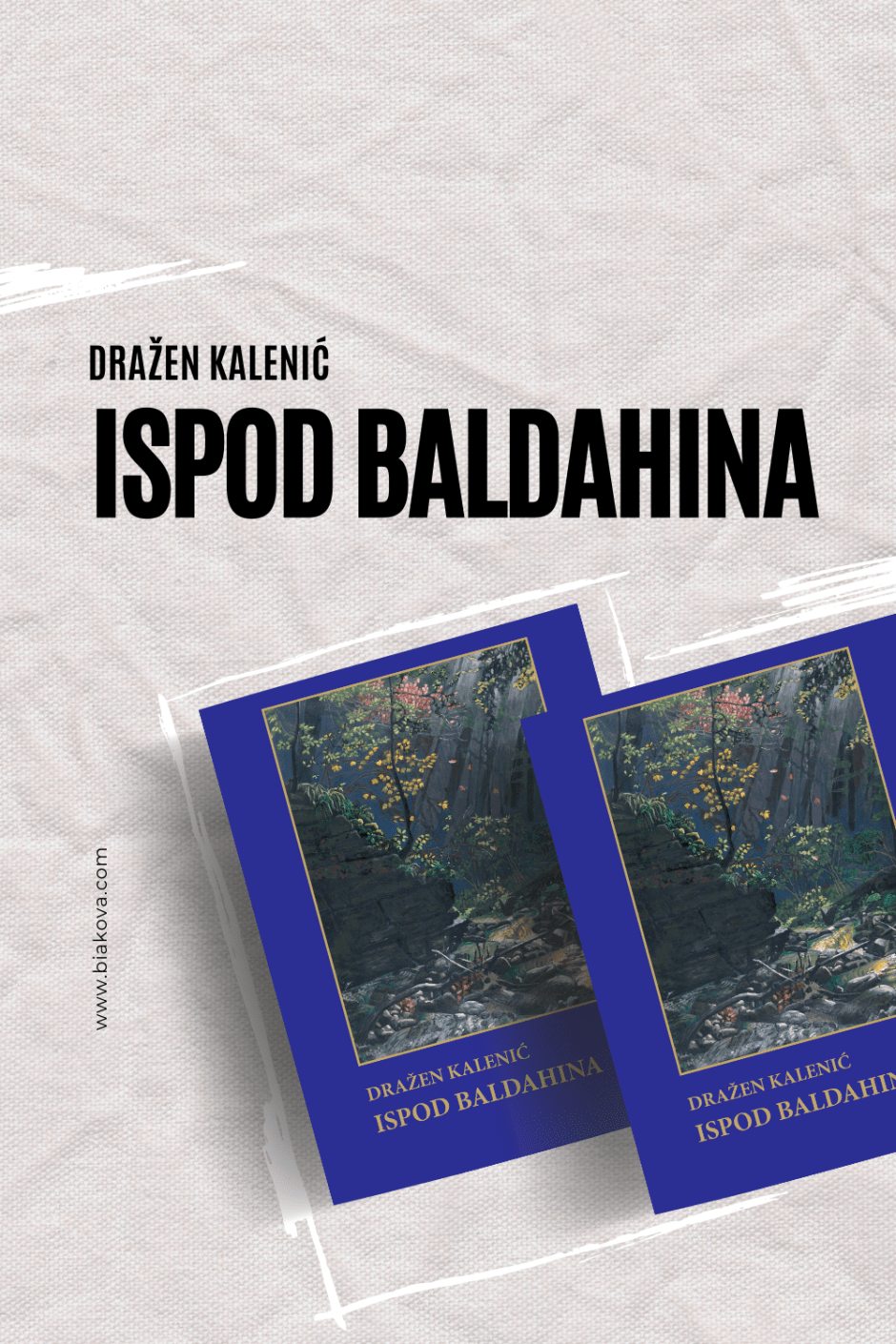
Roman ISPOD BALDAHINA (I. i II. Dio) – BIAKOVA 2024.
The novel UNDERNEATH THE BALDACHIN (Parts I and II)

ISPOD BALDAHINA
Dražen Kalenić
Urednik: Nediljko Bekavac Basić
Slika za naslovoj korici:
Lovro Artuković
“Šumski prizor ko’ stvoren za priču”
Grafička Priprema: Tomislav Klanfar
Naslovnu koricu izradio: Tomislav Klanfar
Uvez: Meki
Broj stranica: 240 str.
Format: A5
ISBN 978-953-8375-72-9
Maloprodajna cijena: 25,20 €
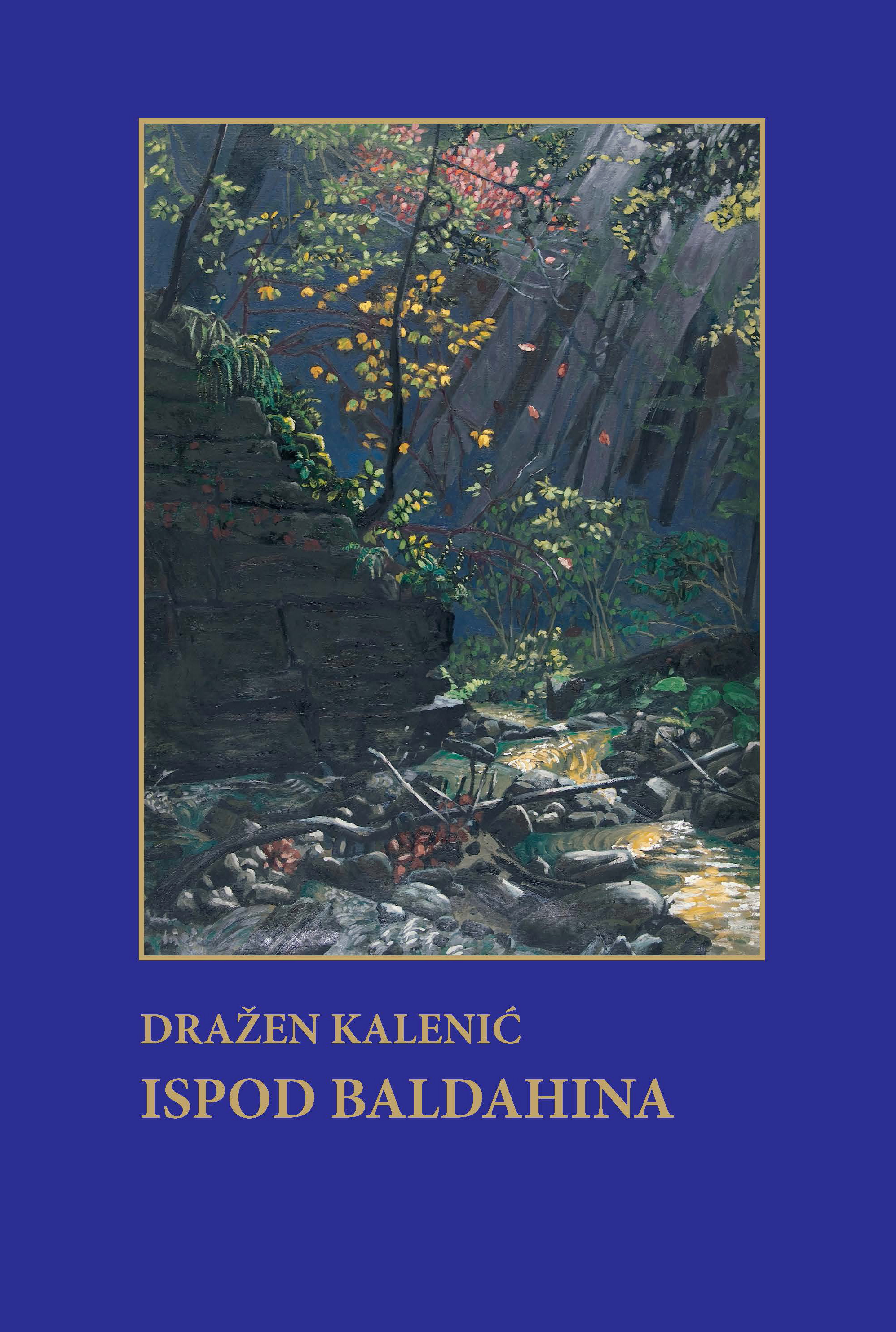
ISPOD BALDAHINA Dražen Kalenić
Uvez: Meki Broj stranica: 240 str. Format: A5 ISBN 978-953-8375-72-9
25,20 €


Roman ISPOD BALDAHINA (I. i II. Dio) – BIAKOVA 2024.
The novel UNDERNEATH THE BALDACHIN (Parts I and II)
Recenzija iz 1997.
Steve Smith, Humanities (Oxford University), o romanu Dražena Kalenića piše ovako: “Knjiga je uistinu vrlo dobra, duboka i poučna…”
Znamo da se danas važne stvari ozbiljno zapostavljaju i da se sve manje vodi računa o neprestanom padu duhovnih vrijednosti; da se rasprava o toj temi odlaže za neka druga, sretnija vremena. Ali za koja to vremena, kad se već evo nalazimo na pragu dvadesetprvog stoljeća?
Kalenić to zna. Hvata se u koštac s ključnim pitanjima našeg vremena dobro procjenjujući koliki je njihov utjecaj i značaj. Spretno nas provlači kroz svoj roman nudeći nam zapravo jednu slojevitu alegoričnu priču, s nizom naoko nebitnih pitanja a koja nam se zapravo svakodnevno nameću, dokazujući time i svoju neprijepornu žilavost na već pomalo letargičnom svjetskom tržištu ideja.
Knjiga se čita u dahu i što je najvažnije: ubrzo shvatimo da se tiče svih nas.
Na koncu konca, svi smo mi ispod baldahina.”
Z. D.
Review from 1997.
Steve Smith, Humanities (Oxford University), writes about Dražen Kalenić’s novel as follows: “The book is truly very good, deep and instructive…”
We know that today important things are seriously neglected and that less and less attention is paid to the constant decline of spiritual values; that the discussion on that topic is postponed for some other, happier times. But for what times, when we are already on the threshold of the twenty-first century?
Kalenić knows that. It tackles the key issues of our time, carefully assessing their impact and significance. He deftly takes us through his novel, offering us a layered allegorical story, with a series of seemingly irrelevant questions that are actually imposed on us every day, thus proving his irrefutable tenacity in the already somewhat lethargic world market of ideas.
The book is read in one breath and what is most important: we soon realize that it concerns all of us. We are all under the same sky.
Z.D.
Prof. Slavko Harni, viši savjetnik za književnost u NSK, napisao je 1998. godine recenziju prvoga dijela romana ISPOD BALDAHINA pod nazivom GDJE SU MOJI PRIJATELJI ILI KRAJ HUMANIZMA. Recenziju prenosimo u cijelosti:
Gdje su moji prijatelji ili kraj humanizma
(Uz roman Dražena Kalenića Ispod baldahina, Zagreb, 1995.)
David, glavni lik romana, što se rodio u vrtu i čije rođenje bijaše događaj bremenit znakovitošću, o kojoj svjedoči i čudak promjenjiva raspoloženja nagovješćujući samovolju Kalenićeve priče. Nakon što je, kao opoziv života i njegove sličnosti čudesnoj varci, doživio svoju prvu ljubav, učinio je osjetnom i time pretvorio svoju prvu pobjedu u poraz. Kalenić će tako već na početku naznačiti sadržaj svojega temeljnoga estetskoga nazora, što ga povjerava svojim likovima, u kojemu se zrcali stanoviti prijezir (ili možda ipak čežnja) prema onome osjetnome, pa i viđenome, a traganje za ljepotom kao nedokučivom, ali ipak ranjivom.
Nakon što je David, hrabrošću koju je od njega iznudio budući prijatelj, ubio vepra, dospijeva do tajanstvenoga starca, a preko njega do „kneza“, do „onih preko rijeke“. Svjedoči jednome ubojstvu, koje je tek početak, jer će zapravo biti poubijani svi. U tome ubijanju međutim nastaje jedan nesporazum.
U gradnju Pergama trebao je biti ugrađen neki tajanstveni predmet, neka žrtva od koje se nejasni obrisi naslućuju iz pričanja. Mladi musliman međutim ne žrtvuje se onako kako su graditelji Pergama, grada što nasilno nastaje umjesto Štita, zamislili, već se žrtvuje za Davida. Zahvaljujući tako znakovitom zauzimanju moralno čistoga čovjeka David preživljava, pa nakon proživljene kliničke smrti, može vidjeti svoj prelijepi vrt sačuvan. Nesporazum, jer David pita za svoje prijatelje, a ne za vrt.
Priča je tako doživjela rasplet u jednome svome sloju. Ona ne nalazi tajanstveni predmet koji je bio razlogom mnogih smrti i koji ima neku sudbonosnu važnost jamstva što ga pruža nevina žrtva. U čemu je taj predmet, kakav je on, koje su njegove moći zapravo, ostaje nam nerazjašnjenim. Ona je dakle više izgovor negoli odgovor. Kalenićevo pričanje ide tako rubom, mimo naslućenoga nacrta. Na rubu je splet izgovora. Priča se razotkriva, ide mimo, proglašava se nevažnom. Svjedočimo jednoj zakrivljenosti priče, njezinoj nedorečenosti, ukazuje se da čak i tolike smrti nisu zapravo glavna stvar. Priča ostaje zapravo neispričana, razgrađena, ukazuje na poriv pričanja možda, razlog pričanja, smisao pričanja koji se međutim ne iskazuje. Priča se iščašuje.
Tom svojom pobunom ona postaje slojevito piščevo kazivanje, ulaz u to kazivanje kojemu je priča pokriće što se hoće otkriti. I u tome je odlučujuća vrijednost i samosvojnost Kalenićevih književnih nastojanja, kojim on istodobno čini kontinuitet ali i diskontinuitet prema zaokupljenostima u književnosti . Riječ je o književnosti citirane asocijacije. U sadržajnoj se slojevitosti, a ne stilskoj besprijekornosti (iako ima i stilski vrlo uvjerljivih dionica), sluti osnovna Kalenićeva zaokupljenost. On se naime priključuje istrazi čovjeka što ga, sve pročišćenije , proučava književnost u nas i u svijetu. Baštineći filozofska nastojanja u zapadnoj misli, ali i pokušaje integriranoga mišljenja o čovjeku kao biću, kojega se može odrediti kao tragatelja za ljepotom. Cilj je traganja, izgleda, ljepota žene te ljepota moralne čiostoće, ali i njihove izloženosti moći i zloći, manipulaciji.
Pokazujući se nepotpunom, zaboravljenom, u neku ruku iznevjerenom pričom čak, Kalenić ne ostavlja ipak dvojbe o tome da je ta iznevjerenost hotimična. Čovjek doduše nosi moralni zakon u sebi, no život ulaže u stvari koje su upitne. Takva pitanja Kalenić obrađuje u obliku rasprava mladih ljudi o načelnim pitanjima ljudskoga života. Onisu su mladenački i nose kadikad zalaz u samovolju priče kad odgovora ponestane. To je međutim drugi mogući pristup ovome djelu. Naglasak na bijegu u priču za razliku od iznevjeravanja priče kao raspleta. One su naime proizvoljne. Prevrednovanje svih vrijednosti, kako bi se uspostavila mjerila moći. Razorna moć je naime ona koja određuje čak i što će se vidjeti. Pa će moralne i svakolike ništarije predstavljati kao besprijekorne i odane ljude, liječnike čak. Čovještvo i izdaja čovještva utjelovljenja u moći temeljna je razdjelnica čovjekova svijeta kojom se zaokuplja Kalenić. Svijetu bezuvjetne volje za moću kao nadmoću on suptilnom i tek naoko grubim prijelazima ponazočuje zanimljivu kritiku zapadne misli. Moć određuje čak i što će se vidjeti. Ta igra moći čini se prozirnom ali joj ne izbjegavamo. Uključujemo se u nju i to kao žrtve.
Gdje su moji prijatelji? To pitanje postavlja David moćniku koji od njega očekuje oduševljenje jer je sačuvao njegov lijepi vrt. Pobuna koja budi nadu, protiv svijeta što nas lišava prijatelja, ukazuje na vrstu ljepote za kojom traga Kalenićev junak. Ne može se uzeti prijatelje a sačuvati ljepotu. Takva se himbenost moći mora prozreti.
Pobuna je u promišljanjima što ih je osobito poduzeo Robert Musil u Čovjeku bez svojstava. Što ga čini mi se razotkriva ukazujući u formi analize Kantova kategoričkog imperativa da dobro treba činiti. A biti dobar? Toje priča za malu djecu. Djecu naime učimo da trebaju biti dobra. Sebi ostavljamo bezuvjetnu obvezu da činimo dobro, a da smo u sebi hulje javna je tajna kako doslovce veli Musil. Tako se bezuvjetni kategorički imperativ stavlja u okvire bezuvjetne volje za moću.
Takav princip međutim čini se čovjekovom sudbinom. U čemu je onda pokriće za humanizam, koji u osnovi vjeruje da je čovjek dobro biće. U Kalenića međutim nikad pobjede bez poraza, nikad svjetla bez sjene, nikad dobra bez zla, a za nečim se ipak traga. Za nekim Pergamom, gradom umjesto Štita. Vrijeme izgubljene nedužnosti, one što se žrtvuje sama.
Zanimanje za čovjeka kao biće interes je ne za njegovu spašenost, već za njegovu kulturu; za višestrukost kulturne pojavnosti , koja moralno nije nevina. Time se dodatno potkrijepljuju razlozi za iskrivljenost, za priču kao izgovor. Dospijevamo do slojevitosti koja se može gledati kao zamršenost, što ljudski život doista i jest.
Kalenićeva priča nije svrhom sama sebi. On nije prije svega zaokupljen primjerice stilskim nastojanjima. On ne doseže jezgrovito dubinu Musila, iako je neobičnih situacija obilje u Kalenića i Musila. On zapravo nije zaokupljen nikakvim dosezanjima. Traganje za ljepotom nije književna već životna zadaća. Nadovezuje se na Goldingovog Gospodara muha, ima filozofske ambicije što slute Marinkovića. Njegov tekst je mjesto susreta kao sudbina.
Kalenićev roman ne spada u lako čitljivu literaturu. Naći ćemo mnoge dobre književnike kojima nije sličan po stilu. Naći ćemo međutim i mnoge izvrsne kojima je sličan. Priča se opire raspletu, koju međutim kao uvjerljivu susrećemo baš na mjestu toga opiranja. Vizija ili hotimice razgrađena priča?
2. svibnja 1998.
Slavko Harni
Prof. Slavko Harni, Senior Advisor for Literature at the National Library of Croatia, wrote a review of the first part of the novel UNDERNEATH THE BALDACHIN in 1998, entitled WHERE ARE MY FRIENDS OR THE END OF HUMANISM.
Where are my friends or the end of humanism
( With Dražen Kalenić’s novel Underneth the Baldachin, Zagreb, 1995.)
David, the main character of the novel, was born in a garden and whose birth was an event fraught with significance, as evidenced by the eccentricity of his changing moods, hinting at the arbitrariness of Kalenić’s story. After experiencing his first love, as a revocation of life and its resemblance to a miraculous illusion, he made it tangible and thereby turned his first victory into defeat. Thus, Kalenić will indicate at the very beginning the content of his fundamental aesthetic view, which he entrusts to his characters, in which a certain contempt (or perhaps a longing) for the tangible, even the visible, is reflected, and the search for beauty as unfathomable, but still vulnerable.
After David, with the courage forced from him by his future friend, kills the boar, he reaches the mysterious old man, and through him to the “prince”, to “those across the river”. He witnesses a murder, which is only the beginning, because in fact everyone will be killed. However, a misunderstanding arises in this killing.
Some mysterious object was to be built into the construction of Pergamum town, some sacrifice whose vague outlines can be guessed from the story. The young Muslim, however, does not sacrifice himself as the builders of Pergamum, the city that violently arises instead of the Shield, imagined, but sacrifices himself for David. Thanks to such a significant commitment of a morally pure man, David survives, and after experiencing clinical death, he can see his beautiful garden preserved. A misunderstanding, because David asks about his friends, not about the garden.
The story thus experiences an unraveling in one of its layers. It does not find a mysterious object that was the reason for many deaths and which has some fateful importance of the guarantee provided by an innocent victim. What this object is, what it is like, what its powers actually are, remains unclear to us. It is therefore more of an excuse than an answer. Kalenić’s story thus goes along the edge, beyond the guessed outline. On the edge is a tangle of excuses. The story is revealed, goes by, declares itself unimportant. We witness a curvature of the story, its incompleteness, it is shown that even so many deaths are not actually the main thing. The story remains in fact untold, decomposed, indicating the urge to tell perhaps, the reason for telling, the meaning of telling that is not expressed, however. The story is dislocated.
With this rebellion, it becomes a layered writer’s narration, an entrance into that narration for which the story is the cover for what is to be revealed. And therein lies the decisive value and originality of Kalenić’s literary efforts, with which he simultaneously creates continuity but also discontinuity towards preoccupations in literature. It is a literature of the It is a literature of cited association. In the layered content, and not in the stylistic flawlessness (although there are also stylistically very convincing sections), one can sense Kalenić’s basic preoccupation. Namely, he joins the investigation of man, which literature in our country and in the world studies, increasingly purified. Inheriting philosophical efforts in Western thought, but also attempts at integrated thinking about man as a being, who can be defined as a seeker of beauty. The aim of the search, it seems, is the beauty of women and the beauty of moral purity, but also their exposure to power and evil, manipulation.
Showing itself to be an incomplete, forgotten, in a way betrayed story, Kalenić still leaves no doubt that this betrayal is intentional. Man does indeed carry the moral law within him, but he invests his life in things that are questionable. Kalenić deals with such questions in the form of young people’s discussions about the fundamental questions of human life. They are youthful and sometimes lead to a descent into the arbitrariness of the story when the answers run out. However, this is another possible approach to this work. The emphasis is on escaping into the story as opposed to betraying the story as an outcome. They are arbitrary. The revaluation of all values, in order to establish the standards of power. Destructive power is the one that even determines what will be seen. So he will present moral and all sorts of nothings as impeccable and loyal people, even doctors. Humanity and the betrayal of humanity embodied in power is the fundamental dividing line of the human world that Kalenić is preoccupied with. To the world of the unconditional will to power as supremacy, he presents an interesting critique of Western thought with subtle and only seemingly rough transitions. Power even determines what will be seen. This game of power seems transparent, but we do not avoid it. We join in it, and as victims.
Where are my friends? This question is asked by David to the powerful man who expects delight from him because he has preserved his beautiful garden. The rebellion that awakens hope, against the world that deprives us of friends, indicates the kind of beauty that Kalenić’s hero is searching for. One cannot take friends and preserve beauty. Such a hypocrisy of power must be seen through.
Rebellion is in the reflections that Robert Musil, in particular, undertook in Man Without Qualities. What makes him is revealed to me by indicating in the form of an analysis of Kant’s categorical imperative that good should be done. And to be good? That is a story for small children. Namely, we teach children that they should be good. We leave ourselves an unconditional obligation to do good, and that we are scoundrels in ourselves is an open secret, as Musil literally says. Thus, the unconditional categorical imperative is placed within the framework of the unconditional will to power.
Such a principle, however, seems to be man’s destiny. What then is the cover for humanism, which fundamentally believes that man is a good being. In Kalenić, however, there is never victory without defeat, never light without shadow, never good without evil, and something is still being sought. For some Pergamum, a city instead of the Shield. The time of lost innocence, that which sacrifices itself.
Interest in man as a being is an interest not in his salvation, but in his culture; in the multiplicity of cultural phenomena, which are not morally innocent. This further substantiates the reasons for distortion, for the story as an excuse. We reach a layering that can be seen as complexity, which human life truly is.
Kalenić’s story is not an end in itself. He is not primarily concerned with stylistic endeavors, for example. He does not reach the concise depth of Musil, although unusual situations abound in Kalenić and Musil. He is not actually concerned with any achievements. The search for beauty is not a literary task but a life task. It builds on Golding’s Lord of the Flies, it has philosophical ambitions that anticipate Marinković (one of the most important Croatian writers). His text is a meeting place like destiny.
Kalenić’s novel does not belong to easily readable literature. We will find many good writers who are not similar in style to him. However, we will also find many excellent ones who are similar to him. The story resists an ending, which we encounter as convincing precisely at the point of this resistance. Vision or deliberately broken story?
May 2, 1998.
Prof. Slavko Harni
Akademik Ante Lib Matić
u svojoj receziji romana kaže: Čitajte Kalenića. Ja sam ga pročitao i bio bogatiji za jednu fantastičnu priču, napisanu finim, britkim hrvatskim jezikom.
Na kraju, imam jednu čudnu sklonost pri čitanju rukopisa i knjiga. Pročitam prvu rečenicu i potom prolistam knjigu i pročitam zadnju. Ako me prva rečenica izazove, nastavim čitati, pa kad dođem do zadnje rečenice i, ako me ta rečenica obraduje i zamisli, umislim da je to dobra priča. Pročitajte prvu i posljednju rečenicu i prosudite sami. „Ako zavučeš ruku u vlastita njedra i napipaš veliku crnu zmiju, ne boj se nego je čvrsto zgrabi, iščupaj i baci daleko od sebe.“ (Zar nije bila zmija u Edenu)
Evo i posljednje rečenice u romanu Ispod baldahina.
Želio ju je napokon zagrliti i reći joj da ju voli, jer je jedino još u pravoj i iskrenoj LJUBAVI pronalazio smisao u svom daljnjem životu. (Bog je ljubav, kaže Ivan)
Academician Ante Lib Matić
says in his review of the novel: Read Kalenić. I read it and was richer for a fantastic story, written in fine, sharp Croatian language.
I have a strange tendency when reading manuscripts and books. I read the first sentence and then leaf through the book and read the last. If the first sentence challenges me, I continue reading, and when I get to the last sentence and, if that sentence makes me happy and thinks, I think it’s a good story. Read the first and last sentences and judge for yourself. If you put your hand in your own bosom and feel a big black snake, don’t be afraid, but grab it tightly, pull it out and throw it far away from you. (Wasn’t there a snake in Eden)
Here is the last sentence in the novel Underneath the Baldaachin.
He wanted to finally hug her and tell her that he loved her, because only in true and sincere LOVE could he still find meaning in his further life. (God is love, says John)
Sinopsis
BALDAHIN je simbol koji u katoličkoj tradiciji simbolizira nebo, što znači cijeli svijet, pa su problemi kojih se knjiga dotiče zapravo problemi svih nas i bilo bi dobro da je pročita što više ljudi.
Knjiga je napisana u dva dijela. Prvi dio je mračan i objavljen je1995. godine, u kojem zlo na kraju pobjeđuje.
Radnja se odvija u idiličnom gradiću Štit, gdje se ljeti okuplja grupa mladih koji većinu svog vremena provodi na obali rijeke i filozofira. Ali jednoga dana u Štit dolazi nevjerojatan bogataš koji će im ubrzo pokvariti tu idilu. Naime, on je odlučio kupiti cijeli Štit i na kraju ga zapaliti. Na njegovom mjestu namjeravao je sagraditi veliki filmski studio. Pokušali su se oduprijeti, ali nisu uspjeli i on ih je dao poubijati. Spasio se samo glavni lik, David.
Drugi dio knjige objavljen je 2024. godine, znači punih dvadeset i devet godina kasnije, i zajedno s prvim dijelom on sada čini cjelinu. Za razliku od prvog dijela, drugi dio je vedar i optimističan, duhovno naklonjen kršćanstvu, iako ISPOD BALDAHINA nije vjerska knjiga. Naime, glavni lik David u njemu nije ostario ni dana, već je samo nastavio priču iz Štita. On tada upoznaje i nove likove. Jedan od njih je i Leon, s kojim odlazi u Saharu, kako bi se zahvalio svom spasiocu Mensuru, koji mu je u prvom dijelu romana spasio život. Njih dvojica zatim odlaze na pješačenje u Santiago de Compostelu, vjerujući da će tamo doživjeti katarzu. Nakon Compostele oni odlaze u Ameriku, gdje vrlo brzo shvaćaju da će se stvari tamo vrlo teško promijeniti, jer se problemi sve više gomilaju. Nakon Amerike razočarano se vraćaju u Europu, ali ipak ne gubeći nadu da će na kraju sve dobro završiti.
Roman „ISPOD BALDAHINA“ govori nam o tome koliko će nam na kraju biti važna LJUBAV, za koju neki danas tvrde da više ne postoji.
Synopsis
THE BALDACHIN is a symbol that in Catholic tradition symbolizes sky, which means the whole world, so the problems that the book touches on are actually the problems of all of us and it would be good for as many people as possible to read it.
The book is written in two parts. The first part is dark and was published in 1995, in which evil ultimately wins.
The action takes place in the idyllic town Shield, where a group of young people gather in the summer and spend most of their time on the riverbank and philosophize. But one day, an incredibly rich man comes to Shield and will soon ruin their idyll. Namely, he decided to buy the entire Shield and eventually burn it down. He intended to build a large film studio in its place. They tried to resist, but they failed and he had them killed. Only the main character, David, was saved.
The second part of the book was published in 2024, a full twenty-nine years later, and together with the first part, it now forms a whole. Unlike the first part, the second part is bright and optimistic, spiritually inclined towards Christianity, although UNDERNEATH THE BALDACHIN is not a religious book. Namely, the main character David has not aged a day in it, but has only continued the story from Shield. He then meets new characters. One of them is Leon, with whom he goes to the Sahara, to thank his savior Mensur, who saved his life in the first part of the novel. The two then go on a hike to Santiago de Compostela, believing that they will experience catharsis there. After Compostela, they go to America, where they very quickly realize that things will be very difficult to change there, because the problems are piling up. After America, they return to Europe disappointed, but still without losing hope that everything will end well in the end. The novel ” UNDERNEATH THE BALDACHIN ” tells us about how important LOVE will be to us in the end, which some today claim no longer exists.
O AUTORU
Dražen Kalenić rođen je 16. 10. 1947. godine u Županji. Od svog najranijeg djetinjstva živi u Zagrebu gdje se školuje i studira tehničke znanosti. Umjetnošću se profesionalno bavi od 1978. godine kroz umjetničku fotografiju i dizajn. Član je ULUPUH-a od 1979. godine, a status samostalnog umjetnika u Hrvatskoj zajednici samostalnih umjetnika (HZSU) dobiva 1983. godine. Tada u potpunosti napušta inženjerski posao i posvećuje se isključivo umjetnosti. Svoj prvi roman „Ispod baldahina“ objavljuje u prosincu 1995. godine. Njegov drugi dio, bez vremenskog pomaka, objavljuje 2024. godine.
ABOUT THE AUTHOR
Dražen Kalenić was born on October 16, 1947 in Županja. Since his earliest childhood, he has lived in Zagreb, where he was educated and studied technical sciences. He has been professionally involved in art since 1978 through artistic photography and design. He has been a member of ULUPUH since 1979, and he received the status of an independent artist in the Croatian Association of Independent Artists (HZSU) in 1983. At that time, he completely left his engineering job and devoted himself exclusively to art. He published his first novel, “Underneath the Baldachin”, in December 1995. His second part, without a time lag, was published in 2024.
O AUTORU DRAŽENU KALENIĆU S INTERNETA
Dražen Kalenić je hrvatski autor, koji je svoj umjetnički put započeo kroz fotografiju i dizajn. Živi u Zagrebu. Nakon studija tehničkih znanosti Kalenić je u potpunosti prešao u svijet umjetnosti. Kao književnik, postao je poznat nakon objave romana Ispod baldahina 1995. godine. Njegov stil odlikuju filozofska razmatranja o ljudskoj prirodi, ljepoti, moralu, moći i kulturi. Njegova djela istražuju složene odnose između dobra i zla, prikazujući ih kroz iskustva i unutarnje sukobe likova, a često u formi dijaloga među mladima koji preispituju osnovna životna pitanja.
Kalenićeva književnost nije usmjerena na stilsku perfekciju već na filozofska i moralna pitanja, gdje se inspirira djelima zapadnih mislioca i književnih klasika kao što je Robert Musil. Uz kritiku društvenih normi i mahanizama moći, Kalenićevi likovi traže ljepotu u prijateljstvu i moralnoj čistoći, te se bore protiv manipulacija i nepravdi koje ih okružuju.
Za više o njegovim književnim postignućima i stilskim karakteristikama možete posjetiti izvore poput Biakove ili Laudato stranice.
ABOUT AUTHOR DRAŽEN KALENIĆ FROM THE INTERNET
Dražen Kalenić is a Croatian author, who began his artistic journey through photography and design. He lives in Zagreb. After studying technical sciences, Kalenić completely moved into the world of art. As a writer, he became famous after the publication of the novel UNDERNEATH THE BALDACHIN in 1995. His style is characterized by philosophical considerations about human nature, beauty, morality, power and culture. His works explore the complex relationships between good and evil, showing them through the experiences and inner conflicts of the characters, often in the form of dialogues between young people who are questioning basic life questions.
Kalenić’s literature is not focused on stylistic perfection but on philosophical and moral issues, where he is inspired by the works of Western thinkers and literary classics such as Robert Musil. Along with criticizing social norms and mechanisms of power, Kalenić’s characters seek beauty in friendship and moral purity, and fight against the manipulations and injustices that surround them.
For more on his literary achievements and stylistic characteristics, you can visit sources such as Biakova’s or Laudato’s site.
 Biakova's Website